
Software Development Contract Checklist: What Clients Should Review Before Signing
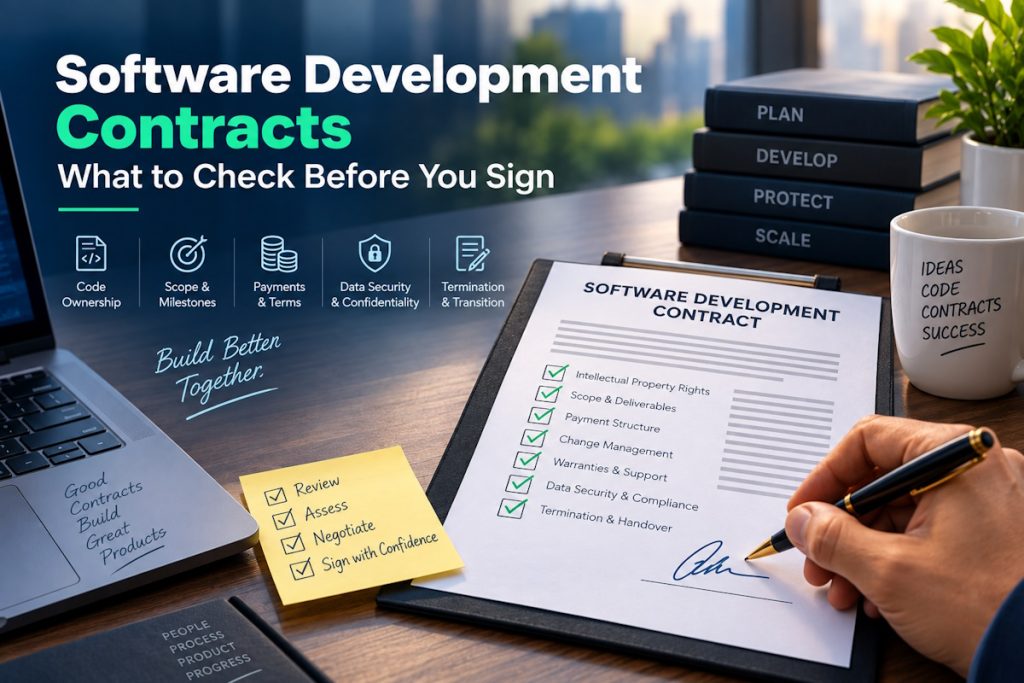
Entering into a custom software initiative without a thoroughly vetted agreement routinely turns promising product visions into expensive disputes. Technology buyers frequently focus on hourly rates, team composition, and delivery roadmaps during negotiations, treating the actual legal paperwork as an administrative formality. When architectural shortcuts emerge, milestones slip, or code repositories are withheld, the language in the contract dictates the entire power dynamic between client and vendor.
A software development contract is not merely a legal safety net; it is an operating manual for technical collaboration. It defines how requirements change, what constitutes acceptable code quality, who owns underlying libraries, and how risks are distributed if development stalls. Evaluating this agreement requires equal input from legal counsel and engineering leadership. Without aligning legal terms with technical realities, organizations risk paying for incomplete products they cannot deploy, modify, or legally own.
Core Structure: Master Services Agreement vs. Statement of Work
Most commercial software engagements rely on a two-part contractual framework consisting of a Master Services Agreement (MSA) and one or more Statements of Work (SOW). The MSA establishes the enduring legal relationship between the parties, addressing governance matters such as confidentiality, indemnification, dispute resolution, and general liability limits. The SOW governs execution details, defining the specific feature scope, project milestones, team allocation, and payment schedules for a defined phase of work.
Problems arise when the boundary between these two documents is blurred or when terms contradict each other. A common mistake is allowing a Statement of Work to quietly alter core IP or liability terms established in the MSA through unreviewed boilerplate clauses. Every software development agreement should contain an explicit order of precedence clause, establishing whether the MSA or the SOW controls when language conflicts.
Engineering and procurement teams must ensure that recurring operational realities live in the SOW, while fundamental risk allocations remain protected in the MSA. If a vendor requires updated development tools, modified milestone deadlines, or altered sprint cycles, those changes should be documented through formal SOW amendments rather than informal email exchanges that legal teams cannot enforce.
Software Intellectual Property and Code Ownership
Clear intellectual property transfer is the most critical component of any software vendor contract. Clients often assume that paying an invoice automatically grants them full ownership of everything the agency builds. Under intellectual property law in most jurisdictions, ownership remains with the author unless explicitly assigned in writing through a comprehensive work-for-hire provision or written assignment clause.
To secure absolute ownership, the contract must address several distinct categories of software intellectual property:
-
- Custom Developed Deliverables: All bespoke source code, database architectures, user interface designs, and technical documentation created specifically for the project must transfer to the client. This transfer should take effect upon creation or, at minimum, upon payment for the specific milestone, rather than after the entire contract finishes.
-
- Vendor Background Technology: Software agencies often use proprietary starter kits, internal development frameworks, or reusable code modules to accelerate development. The agreement must state that if vendor-owned components are embedded in the deliverables, the client receives a perpetual, irrevocable, royalty-free, worldwide license to use, modify, and distribute that code. Without this license, you cannot maintain the application without the vendor.
-
- Third-Party and Open Source Components: Contracts must require vendors to disclose all open-source libraries and commercial third-party dependencies used in the project. The contract should strictly prohibit the incorporation of copyleft licenses (such as GPL or AGPL) that could legally compel your organization to disclose its proprietary source code to the public.
Ensuring complete ownership also means verifying access to the development environment throughout the build. The contract must mandate continuous access to the raw source code repositories, deployment pipelines, and project boards, preventing the vendor from withholding code assets during financial or scope disagreements.
Scope Definition, Milestones, and Acceptance Testing Criteria
Ambiguity around project deliverables is the leading driver of budget overruns and operational friction. A vendor contract should never rely on broad marketing terms such as “build a scalable modern platform.” The agreement needs precise technical definitions that outline functional requirements, performance expectations, supported environments, and integration boundaries.
Requirements established during software architecture planning should translate into measurable technical obligations within the SOW. This can include infrastructure requirements, integration boundaries, scalability expectations, security considerations, and dependencies that could materially affect delivery.
Equally critical is a clearly documented acceptance testing procedure. Signing an agreement that ties payments directly to calendar dates rather than verified technical milestones removes your leverage to demand complete work. A balanced acceptance framework contains specific components:
-
- A Defined Review Window: The client should have a reasonable evaluation period, typically 10 to 15 business days, to run functional and non-functional tests against delivered builds.
-
- Objective Acceptance Criteria: Deliverables should be measured against clear, objective specifications rather than subjective vendor opinions. This includes functional accuracy, response times, security scans, and cross-platform compatibility.
-
- Rejection Mechanics and Remediation: If a milestone fails acceptance, the agreement must require the vendor to remediate defects at their own expense within a set timeframe. Crucially, client silence should never be construed as automatic acceptance without reasonable written notice.
Pricing Models and Invoicing Mechanics
The chosen commercial model directly shapes project governance and risk allocation. Whether using a fixed-price arrangement or a time-and-materials (T&M) framework, the contract must establish how funds are disbursed and how effort is measured.
In fixed-price engagements, vendors carry the financial risk of delivery overruns, but they frequently manage that risk by strictly limiting project scope and charging aggressive fees for any modification. In these agreements, ensure that acceptance gates are unmistakably tied to specific deliverables, not arbitrary calendar dates. Be cautious of front-loaded payment structures where 50% or more of the capital is paid before meaningful software is deployed to a staging environment.
For time-and-materials engagements, which are common in agile environments, the client carries the financial risk. Your software development contract must include guardrails to prevent uncontrolled billing. Essential provisions include detailed time tracking with weekly timesheet approvals, predefined billing increments, individual team member bill rates, and a formal process for adding or replacing technical personnel. A time-and-materials agreement should also feature a non-binding budget cap that requires written authorization before billable hours can exceed initial estimates.
Change Management and Scope Creep Governance
Software requirements invariably change as real users interact with prototypes and business conditions evolve. Problems arise when changes happen casually over messaging platforms or phone calls without a contractual framework to evaluate their impact on cost and schedule.
A rigorous software outsourcing contract must contain a formal change control procedure. This clause mandates that any proposed change to system architecture, user flows, or integration requirements must be documented in a written Change Order. The vendor must provide a concrete impact analysis showing the required engineering hours, cost changes, and adjustments to delivery timelines before any work begins.
By enforcing this rule, clients prevent unauthorized work from appearing on subsequent invoices. It forces both product managers and external developers to calculate the true cost of new features before diverting resources from foundational work.
Code Quality, Warranties, and Post-Launch Support
Once final payment is made, resolving bugs becomes difficult unless the contract explicitly defines warranty commitments. Many vendors propose contracts that deliver software on an “as is” basis, effectively disclaiming all responsibility for performance failures once the code leaves their local machines.
Clients should require an explicit warranty period, typically lasting 30 to 90 days following commercial production release. During this warranty window, the vendor must agree to fix any defects or bugs that deviate from the agreed specifications at zero additional cost. The agreement should define severity levels for defects, along with concrete response and resolution times for mission-critical failures.
Beyond bug fixes, the contract should outline code quality standards. Require clean, readable, documented code that adheres to standard industry conventions. The vendor should commit to providing comprehensive system architecture documentation, installation scripts, API schemas, and deployment instructions so internal engineers or third-party teams can take over the codebase without vendor dependency.
Data Security, Privacy, and Confidentiality Obligations
Software engagements require granting external teams access to proprietary business logic, staging servers, corporate APIs, and sometimes sensitive production data. The confidentiality and data handling sections of a software vendor contract must reflect this reality.
Standard non-disclosure clauses are rarely enough for modern applications. The contract should outline specific operational security obligations, including:
-
- Access Control Standards: Mandating multi-factor authentication, role-based access controls, and immediate credential revocation for departing agency personnel.
-
- Regulatory Compliance: Requiring compliance with applicable privacy frameworks depending on your jurisdiction and industry, such as GDPR, HIPAA, or SOC 2 guidelines.
-
- Vulnerability Management: Obligating the vendor to conduct routine vulnerability scans, dependency audits, and static code analysis prior to deployment, alongside a mandate to remediate critical security vulnerabilities before production sign-off.
-
- Data Breach Protocols: Requiring prompt written notification within a defined window (such as 24 to 48 hours) if any data compromise or unauthorized access is suspected.
Termination, Transition Assistance, and Vendor Lock-in
No organization signs a development agreement anticipating that the relationship will collapse, yet failing to negotiate termination clauses is a severe strategic error. When relationships sour, companies without clear exit provisions often find themselves locked out of repositories, holding broken code, and facing lawsuits over disputed invoices.
Your contract must include provisions for termination for cause (such as ongoing milestone failures or material breach) and termination for convenience, which allows you to cancel the project with reasonable written notice (typically 14 to 30 days) while paying only for work completed to date.
More importantly, the agreement must mandate transition assistance. Upon termination, the vendor must be contractually required to transfer all current code branches, database dumps, third-party accounts, and deployment keys to your team within a strict timeframe. They should also be obligated to provide handover sessions at an agreed hourly rate to brief incoming engineers. Without these termination transition requirements, vendors hold immense leverage over your timeline and investment.
What to Verify Before Final Execution
Before executing any software development contract, engineering leaders and procurement managers should conduct a final joint review. Step away from the high-level commercials and examine the tactical provisions that dictate day-to-day operations.
Confirm that your team has absolute, unencumbered ownership of custom source code and clear licensing for reusable frameworks. Verify that payment schedules match measurable technical deliverables rather than elapsed time on a calendar. Ensure that the change management workflow is clear, that the warranty window protects your production launch, and that the vendor cannot hold your digital assets hostage if a billing disagreement arises.
Treating the contract as a core engineering document aligns expectations on both sides of the table. A balanced agreement protects your company’s balance sheet, preserves your intellectual property, and provides a clear technical roadmap for a successful deployment.
Frequently Asked Questions
1. What is the difference between an MSA and an SOW?
A Master Services Agreement (MSA) establishes the broad legal and relationship terms that govern all interactions between client and vendor, covering liability, IP rights, confidentiality, and termination. A Statement of Work (SOW) sits under the MSA and defines project-specific execution details, including feature scope, milestones, timelines, and payment terms for a specific initiative.
2. When should intellectual property be transferred to the client?
Intellectual property should ideally transfer automatically upon creation or upon payment for each specific milestone. Avoid agreements where IP rights only transfer after the entire contract is completed, as this leaves you with zero legal ownership of interim code if the project terminates early.
3. How long should a software development warranty last?
A standard software development warranty typically lasts between 30 and 90 days after commercial deployment. During this window, the vendor is obligated to correct any bugs, defects, or deviations from the functional specifications at their own expense.
4. What should be included in an acceptance testing clause?
An acceptance testing clause should include an agreed evaluation timeframe (usually 10 to 15 business days), objective functional and technical criteria for passing, a formal written notification process for defects, and a set window for the vendor to remediate issues. It should also specify that silence from the client does not constitute automatic acceptance.
5. How can clients protect themselves against vendor scope creep?
Protection against scope creep requires an explicit change control procedure in the contract. This clause must state that any modification to project scope, architecture, or deliverables requires a written Change Order detailing the exact impact on cost and schedule before work begins, preventing unauthorized hours from appearing on invoices.
