
How to Plan Software Architecture for Growth Without Overengineering
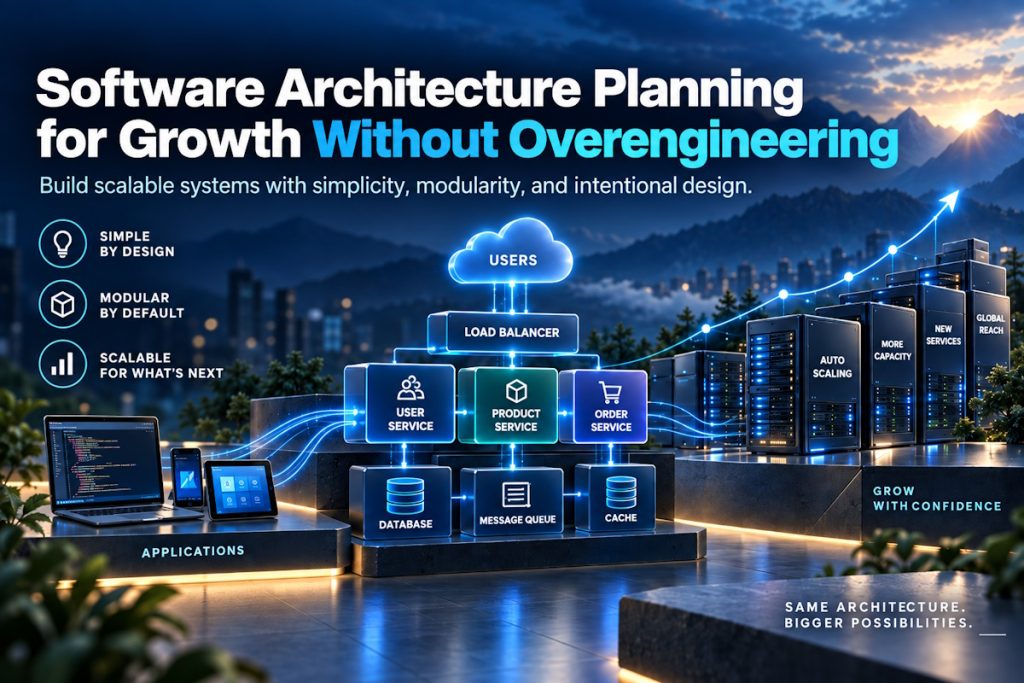
Engineering teams frequently grapple with an expensive dilemma: building an architecture that collapses under early traction or designing an elaborate, hyper-scalable system that burns capital before finding product-market fit. The pressure to prepare for hypothetical millions of users often leads teams to adopt distributed systems, complex event meshes, and fractured microservice topologies before they understand their domain boundaries. This premature complexity inflates infrastructure bills, slows down feature velocity, and introduces operational failure modes that small teams are ill-equipped to debug.
Conversely, completely ignoring future demands creates brittle codebases where single database locks stall business operations and tight coupling prevents independent team deployments. Effective software architecture planning is not about predicting every technological requirement five years into the future. It is about creating clear separation of concerns, identifying genuine operational bottlenecks, and applying software design for change principles that preserve your ability to adapt as the business grows.
The True Cost of Premature Architectural Complexity
Overengineering often stems from good engineering intentions combined with misplaced priorities. When architects design systems for scale they do not yet need, the business pays a compounding penalty across three distinct areas: development velocity, operational overhead, and cognitive load.
Every distributed component introduced into an application architecture demands dedicated networking, telemetry, automated testing, deployment pipelines, and failure-handling strategies. Instead of shipping customer-facing features, engineers spend valuable cycles addressing network latency, eventual consistency glitches, distributed transaction management, and service orchestration. For early-stage products and new enterprise initiatives alike, delivery speed is the ultimate risk mitigation tool. Sacrificing speed for unnecessary technical sophistication creates organizational friction without providing measurable commercial benefit.
Furthermore, premature decomposition into distributed components often draws boundaries in the wrong places. When business models evolve, engineers find themselves executing cross-service refactors that require complex, coordinated deployments across multiple repositories. A modular system architecture contained within a single deployable artifact is dramatically easier to reorganize than a scattered fleet of loosely integrated services.
Foundations of Pragmatic Software Architecture Planning
Disciplined software architecture planning requires viewing system design through the lens of optionality and incremental investment. Rather than guessing future traffic patterns, technical leaders should focus on core principles that keep systems adaptable.
Designing Clean Domain Boundaries
Modularity matters far more than physical service separation. A well-structured monolith with strict module boundaries, explicit interfaces, and isolated database tables provides almost all the structural benefits of microservices without operational overhead. By enforcing domain-driven boundaries within your code, you ensure that individual business domains remain decoupled. If a specific domain eventually experiences extreme load or requires separate deployment cadences, extracting it into an independent service becomes a predictable engineering task rather than a rewrite.
Isolating Data Access and State Management
State is usually the hardest thing to change in production systems. Software scalability problems almost always manifest at the database layer before they manifest in compute layers. Sensible architectural planning establishes clear rules around data access:
-
- Ensure that modules or services interact with other domains only through well-defined APIs rather than querying another domain’s database tables directly.
-
- Separate transactional read operations from heavy analytical or reporting workloads early, preventing operational database degradation.
-
- Avoid complex database-level triggers and business logic that lock you into specific database engines and obscure system behavior.
Decoupling Compute from Storage
Stateless application servers are simple to scale horizontally behind a basic load balancer. Designing your application architecture so that compute instances hold no persistent local session state allows your infrastructure to expand and contract automatically with traffic demands. Offload session management, temporary caching, and file storage to dedicated managed infrastructure like external caches and object storage services.
Distinguishing Essential Scalability from Premature Optimization
Engineering teams must learn to differentiate between scalable software architecture principles that cost very little to implement early and premature optimizations that consume immense resources. Knowing what to build today versus what to defer can save months of engineering effort.
What to Implement Early
Certain architectural practices introduce negligible complexity when established from the start, but are exceptionally painful to retrofit later:
-
- Asynchronous Task Processing: Offloading email delivery, file transformations, webhook calls, and third-party API communications to a simple background queue protects core transactional performance and isolates the user experience from downstream latency.
-
- Structured Logging and Centralized Telemetry: Establishing consistent correlation IDs, error tracking, and request metrics early gives engineering teams visibility into performance hotspots long before system limits are reached.
-
- Database Indexing and Query Discipline: Writing efficient queries, avoiding N+1 database calls, and establishing basic indexing strategies require minimal effort during initial development but yield dramatic performance dividends.
-
- Idempotency Mechanisms: Designing critical API endpoints and background workers to handle duplicate requests gracefully prevents catastrophic data corruption during network retries or queue re-deliveries.
What to Defer Until Traffic Demands It
Other architectural patterns are best deferred until concrete telemetry and business scale justify the maintenance investment:
-
- Database Sharding: Sharding introduces severe operational friction, eliminates straightforward relational joins, and complicates data backups. Vertical scaling, read replicas, and caching strategies typically carry systems to massive transaction volumes before sharding is warranted.
-
- Complex Distributed Microservices: Decomposing your application across dozens of independent services before your engineering organization grows to multiple autonomous product teams simply slows down deployment frequency.
-
- Custom Event Streaming Infrastructures: Highly complex distributed event streaming brokers introduce significant configuration and operational overhead that simple relational databases or managed queues can handle adequately at lower volumes.
-
- Multi-Region Active-Active Deployments: Multi-region data synchronization requires handling complex network partitions and conflict resolution mechanisms. A reliable single-region deployment with solid disaster recovery backups is often sufficient until strict geographic latency or regulatory requirements dictate otherwise.
A Progressive Decision Framework for System Evolution
Scalability is not a binary state; it is a continuum that evolves alongside customer demand and organizational maturity. Instead of designing for an imagined end state, map out progressive inflection points that trigger architectural transitions.
Stage One: The Well-Structured Modular Core
In the initial phase of product delivery, prioritize simplicity and delivery speed. Deploy a single well-structured application supported by a managed relational database and a lightweight background queue. Emphasize comprehensive automated integration tests, clear domain interfaces, and strict boundary separation. This phase allows the team to iterate rapidly, understand customer workflows, and validate product viability without infrastructure distraction.
Stage Two: Strategic Workload Offloading
As user activity increases, compute and database resources will show measurable strain. Rather than fragmenting the application, introduce focused optimizations based on real profiling data:
-
- Introduce a managed caching layer for expensive, frequently read, slow-changing database queries.
-
- Implement read replicas to relieve your primary database of read-heavy traffic.
-
- Establish asynchronous pub-sub patterns for non-critical downstream notifications, analytics updates, and search index syncs.
-
- Use a content delivery network to serve static assets and cache edge-friendly API responses.
Stage Three: Targeted Service Extraction
Only when individual components exhibit vastly different resource requirements, scaling dynamics, or team ownership boundaries should you extract them into dedicated services. For example, a video transcoding pipeline, an algorithmic search engine, or a high-frequency payment processing engine may justify isolation from the primary monolith. Because you maintained clean domain boundaries during earlier stages, this extraction occurs along logical structural lines with minimal friction.
Aligning Technical Decisions with Business Realities
Technical architecture does not exist in isolation from organizational economics. Every technology decision carries an ongoing operational carrying cost that impacts budget allocation, hiring requirements, and deployment safety.
When evaluating an architectural enhancement, ask whether the operational complexity is offset by tangible business value. A complex system architecture that requires hiring specialized distributed-systems engineers may strain a startup budget. Conversely, an enterprise modernization project with multiple independent business units might require service isolation earlier simply to decouple team release cycles.
Document these decisions using lightweight Architectural Decision Records. Recording the business context, technical assumptions, evaluated alternatives, and accepted tradeoffs ensures that future engineers understand why specific choices were made. This documentation prevents teams from prematurely rewriting stable systems or re-introducing past architectural vulnerabilities when organizational personnel shifts occur.
Guiding Architectural Decisions Toward Sustainable Growth
Sustainable software architecture planning is characterized by restraint, clarity, and adaptability. Successful engineering organizations do not build complex distributed networks to demonstrate technical ambition. They build reliable, modular foundations that solve current business challenges while keeping future architectural options open.
By establishing rigorous domain boundaries, prioritizing simplicity, observing real operational metrics, and deferring non-essential distributed patterns, technology leaders ensure their systems scale smoothly. The ultimate test of an application architecture is not whether it could handle the traffic of a global tech giant tomorrow, but whether it empowers your team to deliver dependable business value today while retaining the flexibility to grow alongside tomorrow’s opportunities.
Frequently Asked Questions
1. What is the difference between scalable software architecture and overengineering?
Scalable software architecture uses clean modular boundaries, efficient data access, and decoupled state to allow systems to handle increased demand with minimal friction. Overengineering implements complex distributed patterns, microservices, or custom infrastructure for hypothetical scale long before operational data justifies the overhead.
2. When should a growing engineering team transition from a monolith to microservices?
A transition to microservices is typically justified when organizational complexity, rather than purely technical load, demands it. When multiple independent development teams experience deployment bottlenecks, merge conflicts, and release coordination delays within a shared codebase, extracting decoupled services helps restore team autonomy.
3. How does database design affect long-term software scalability?
Database bottlenecks are the most common cause of system scalability limits. Inefficient schemas, missing indexes, unmanaged table locks, and direct cross-domain queries can degrade performance rapidly. Designing systems with decoupled data models and isolating transactional operations from heavy analytical workloads preserves long-term scalability.
4. How can technology leaders assess if an architecture is overengineered?
Warning signs include declining feature velocity, excessive operational maintenance, difficult local developer onboarding, complex cross-service debugging, and high infrastructure costs relative to active user volume. If simple features require coordinated changes across multiple services, the system architecture is likely overengineered.
5. Why is asynchronous processing critical in early application architecture?
Asynchronous processing prevents long-running tasks, such as third-party API requests, file generation, and email dispatches, from blocking user-facing web requests. Offloading these tasks to background queues improves application responsiveness, isolates failure points, and enhances system reliability with minimal added architectural complexity.
