
AI-Generated Apps vs. Custom Software: When to Hire an Agency and When to Keep It In-House
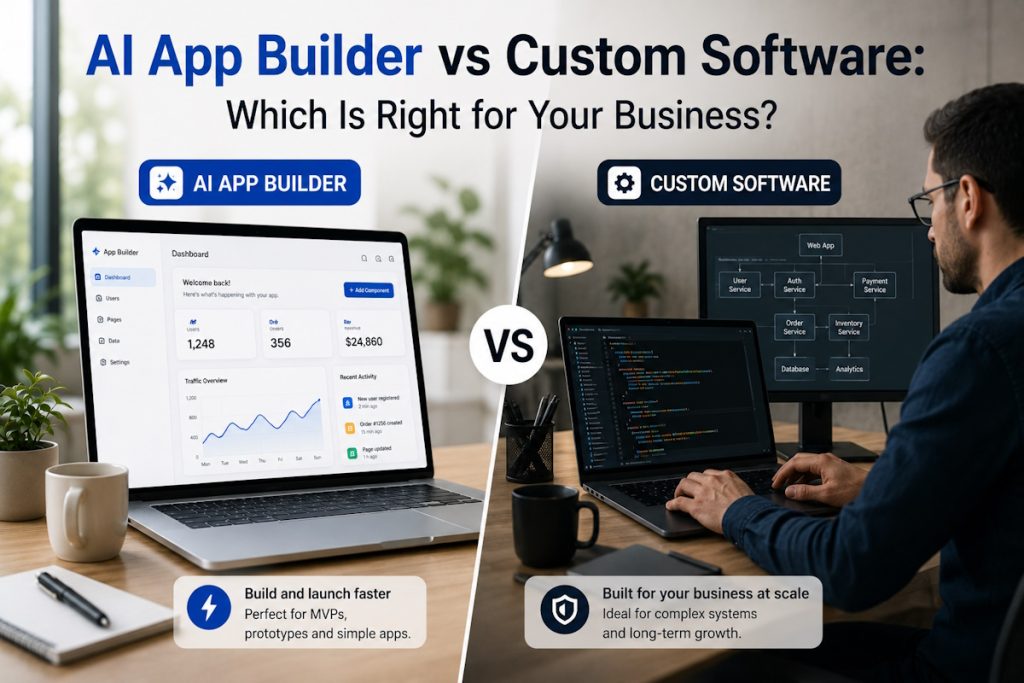
Building software is no longer limited to companies with large development teams and big budgets. AI tools have changed how businesses create apps, test ideas, and launch digital products. Today, even a small team can use an AI app builder to create a working product much faster than traditional development.
However, faster development does not always mean an AI-generated app is the right choice. Some projects need custom software, experienced developers, strong security, detailed planning, and long-term support.
This creates an important question for business owners and product teams: should you build software in-house using AI tools, or should you hire a software development agency?
Understanding the difference between an AI app builder vs custom software can help you make the right decision. The best choice depends on your goals, budget, technical needs, timeline, and plans for growth.
What Is an AI App Builder?
An AI app builder is a tool that helps people create software with less manual coding. Instead of writing every line of code, users can describe what they want the application to do.
For example, you might ask an AI tool to create a customer dashboard where users can sign in, view orders, update their profiles, and contact support.
The AI system may then create parts of the interface, database, workflows, or working code.
This makes software development more accessible. Founders, marketers, product managers, and small business owners can create simple applications without having a large development team.
AI app builders are especially useful when speed matters. They allow businesses to test ideas before making a large investment in development.
What Is Custom Software?
Custom software is designed and developed for the specific needs of a business or group of users.
It can include mobile apps, customer portals, internal systems, marketplaces, automation platforms, booking systems, financial tools, and other business applications.
Unlike many AI-generated apps, custom software gives businesses greater control over how the product works.
Developers can decide how data is stored, how different systems connect, how users interact with the application, and how the software handles future growth.
Custom development usually takes more time and costs more at the beginning, but it can provide greater flexibility for complex or long-term projects.
AI App Builder vs Custom Software: What Is the Main Difference?
The main difference between an AI app builder vs custom software comes down to speed, control, flexibility, and complexity.
AI app builders focus on making development faster and easier. They are useful when you want to create a simple product, test an idea, or build an internal tool without spending months on development.
Custom software focuses on building a solution around the exact needs of a business.
For example, imagine you need a simple appointment booking app. An AI app builder may be able to create user registration, appointment scheduling, notifications, basic payments, and an admin dashboard.
For many small businesses, that may be enough.
Now imagine the same booking system needs to support thousands of users, connect with several business systems, manage complex pricing, offer different user roles, and meet strict security requirements.
In that situation, custom software may be the better choice.
When an AI App Builder Makes Sense
AI app builders are useful when the project is simple and speed is one of your main goals.
A common use case is testing a new business idea.
Before spending a large amount of money on development, a business may want to know whether customers are actually interested in the product. An AI app builder can help create a minimum viable product, or MVP, quickly.
The MVP does not need every possible feature. It only needs enough features to test the main idea.
For example, a founder planning a project management platform could create a basic version with tasks, team members, deadlines, and notifications.
Instead of spending months building a complete platform, the founder can launch a smaller version, collect feedback, and decide what to build next.
AI app builders can also work well for simple internal tools, dashboards, forms, employee systems, and basic automation.
When Keeping Development In-House Makes Sense
Keeping software development in-house can be a good choice when your team understands both the business problem and the technology needed to solve it.
Your employees already understand your customers, processes, and goals. This can make decision-making faster because there is less need to explain how the business works to an outside team.
An internal team can also make changes quickly.
For example, if your sales team needs a small change to an internal dashboard, an in-house developer may be able to make it without starting a separate project with an outside company.
AI tools make this approach even more useful. Developers can use AI to help write code, create tests, fix bugs, and build features faster.
However, in-house development works best when your team has enough technical knowledge to maintain the software after launch.
Building the first version is only the beginning. Someone still needs to manage updates, security, bugs, performance, and future improvements.
When Should You Hire a Software Development Agency?
There comes a point when software becomes too important or too complex to depend only on AI-generated code or a small internal team.
This is where hiring an experienced software development agency can make sense.
An agency can bring together developers, designers, product experts, testers, and other technical professionals.
This is especially valuable when you are turning ideas into software products that need to serve real customers.
A professional software product may require product planning, user experience design, database planning, security, cloud infrastructure, testing, third-party integrations, performance improvements, and ongoing support.
An experienced agency can look at the full product instead of focusing only on individual features.
Hire an Agency When the Product Is Complex
Simple applications can often be created with AI tools. Complex software is different.
If your application has many connected features, several types of users, complex workflows, or large amounts of data, experienced developers may be necessary.
For example, creating a simple contact form is very different from building an insurance platform.
An insurance platform may need customer accounts, document uploads, payments, claims management, employee dashboards, reports, security controls, and connections with other systems.
An AI app builder may help create an early version, but relying only on generated code can become difficult as the platform grows.
Hire an Agency When Security Matters
Security should be an important part of your AI software strategy.
If your software handles customer information, financial details, private documents, health information, or important business data, you need to carefully consider how the application is built.
AI-generated code can save time, but it can also contain mistakes that are difficult for a non-technical user to notice.
A professional development team can review code, test the system, manage access to information, and include stronger security practices from the beginning.
This can reduce the risk of serious problems after launch.
Hire an Agency When Software Is Core to Your Business
Ask yourself a simple question: what happens if this software stops working?
If your business cannot operate properly without it, the software deserves greater technical attention.
A small internal tool used to store meeting notes may not need custom development.
A platform that manages customer orders, payments, deliveries, subscriptions, or daily operations is different.
When software is a core part of the business, reliability becomes very important.
You also need to think beyond the first launch. The system should continue working as the number of customers, employees, features, and data grows.
Hire an Agency When You Need to Scale
An app that works well for 50 users may not perform the same way when 50,000 people start using it.
More users mean more traffic, more data, and greater pressure on the system.
A custom software team can build the application with future growth in mind. This can include better database planning, cloud infrastructure, backups, monitoring, and performance testing.
If you already expect your product to grow quickly, building a strong technical base early can save time and money later.
AI Software Strategy Should Come Before the Tool
One common mistake businesses make is choosing the technology before clearly understanding the problem.
A company may hear about a new AI development platform and immediately decide to build an app with it.
A better approach is to first create an AI software strategy.
Before choosing a tool, ask questions such as:
- What problem are we solving?
- Who will use the software?
- Which features are most important?
- How sensitive is the data?
- How many users do we expect?
- What existing systems need to connect with the app?
- How quickly do we need to launch?
- Who will maintain the software?
Once these questions are clear, deciding between an AI app builder, an internal team, and a software agency becomes much easier.
The technology should support your business goals, not decide them.
A Hybrid Approach Can Be the Best Choice
The decision does not always have to be completely in-house or completely outsourced.
Many businesses can benefit from combining both approaches.
For example, your internal team can use an AI app builder to create a prototype and test the idea with users. Once the idea has been proven, an agency can help turn that prototype into a stronger custom product.
Another option is to let an agency build the main platform while your internal team manages smaller tools, reports, experiments, and updates.
Software agencies can also use AI tools to speed up their own development process.
Custom development does not mean that every line of code has to be written manually. Experienced developers can use AI while still providing human review, technical planning, testing, and security checks.
This approach can provide the speed of AI while keeping the benefits of professional software development.
Turning Ideas Into Software Products Requires More Than Code
One important point to remember is that turning ideas into software products involves much more than simply writing code.
A successful software product needs a clear purpose, useful features, a simple user experience, reliable technology, customer feedback, and regular improvements.
AI can support many parts of this process.
It can help teams create prototypes, generate code, test features, analyze feedback, and speed up repetitive development tasks.
However, human decisions still matter.
Someone needs to understand what customers actually need. Someone needs to choose the right features. Someone also needs to make sure the product is secure, reliable, and connected to the long-term goals of the business.
How to Make the Right Decision
When comparing an AI app builder vs custom software, avoid making the decision based only on the initial development cost.
Think about the full life of the product.
For a simple experiment, MVP, or internal tool, an AI app builder may be the faster and more practical option.
For a product that requires advanced features, strong security, custom integrations, or support for large numbers of users, custom software may offer better long-term value.
Keeping development in-house makes sense when your team has the skills, resources, and time to manage the product.
Hiring an agency makes sense when you need specialist knowledge, a larger development team, stronger technical planning, or experience with complex software.
Your approach can also change as the product grows. You can start with an AI-generated prototype and move to custom development after proving the idea.
Final Thoughts
AI has made software development faster and more accessible. Businesses no longer need a large development department just to test a digital idea.
AI app builders can be a smart choice for prototypes, MVPs, internal tools, and simple applications. They can help teams save time, reduce early development costs, and test ideas faster.
However, speed should not be the only factor.
When software becomes complex, handles sensitive information, supports many users, or plays an important role in business operations, professional custom development can be a better choice.
The real question in the AI app builder vs custom software discussion is not which option is always better. It is which option fits your current business needs.
A clear AI software strategy can help you make that decision based on your goals, users, risks, budget, and future plans.
For many businesses, the best approach is to use AI where it saves time and experienced developers where deeper technical knowledge is needed. This balance can make turning ideas into software products faster, safer, and more practical.
Frequently Asked Questions
1. What is the difference between an AI app builder and custom software?
An AI app builder creates apps quickly with less coding, while custom software is built for specific business needs. In the AI app builder vs custom software choice, AI tools suit simpler projects, while custom software offers more control and flexibility.
2. When should I use an AI app builder?
Use an AI app builder for prototypes, MVPs, simple internal tools, or when you need to test an idea quickly with a smaller budget.
3. When should I hire a software development agency?
Hire an agency when your project needs complex features, strong security, custom integrations, or support for future growth. Agencies can also help with turning ideas into software products.
4. Can AI app builders replace software developers?
Not completely. AI can speed up development, but experienced developers are still important for complex systems, security, testing, and a strong AI software strategy.
5. Should I build software in-house or hire an agency?
Build in-house if your team has the right skills and the project is manageable. Hire an agency when you need more technical experience, faster development, or help building a complex product.
