
What Happens When Companies Add AI to Software Without a Business Strategy
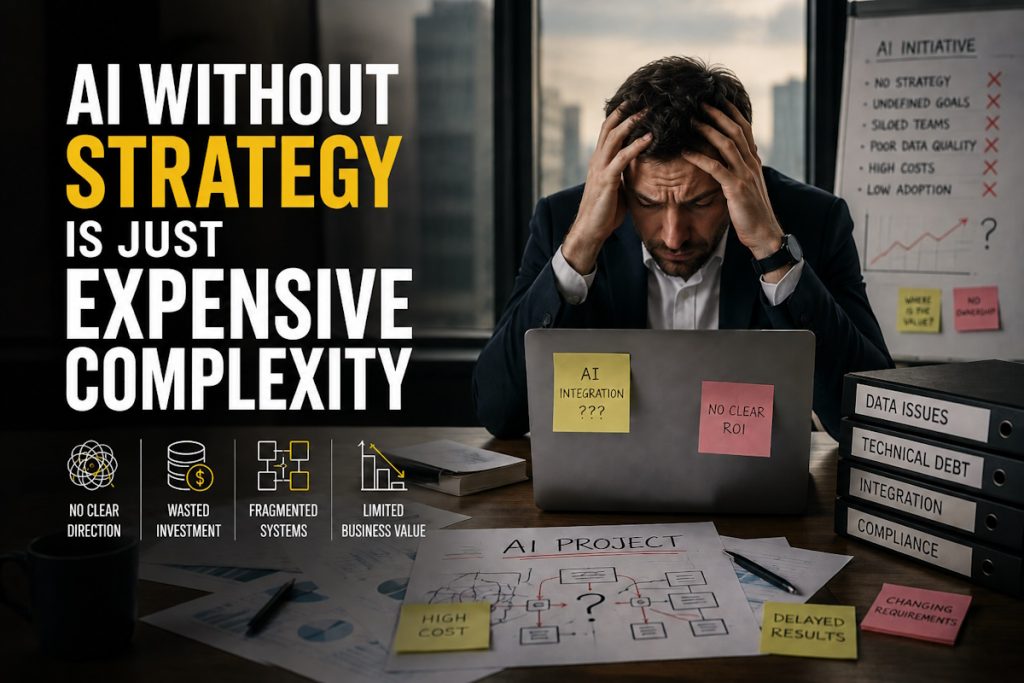
In the rush to capture market attention, many business leaders demand that their engineering teams add artificial intelligence to existing products as quickly as possible. This pressure often results in hurried integrations, where machine learning models or third-party APIs are hastily patched onto legacy systems. Without a clear business purpose, these features quickly turn into expensive gimmicks that fail to drive user engagement or generate revenue. For companies looking to outsource their development, the risk is even higher if they select a vendor that prioritizes buzzwords over architectural sustainability.
To avoid these pitfalls, organizations must establish a comprehensive AI software strategy before writing a single line of code. Slapping an AI feature onto your application without aligning it with long-term business goals can lead to massive technical debt, unpredictable cloud infrastructure costs, and a poor user experience. When searching for external technology partners, it is critical to evaluate how they plan to integrate these complex technologies into your product roadmap. A strategic partner will focus on business value, system architecture, and sustainable scalability rather than trendy, short-term additions.
The Structural and Financial Risks of Strategy-Free AI
Deploying artificial intelligence is fundamentally different from building traditional software features. Traditional applications follow predictable, rules-based logic, whereas AI systems rely on probabilistic data models that require continuous monitoring, retraining, and optimization. When companies bypass strategic planning, they risk building fragile systems that are highly prone to failure.
Unpredictable Operational and API Costs
Many businesses rely heavily on third-party APIs to power their AI features, assuming that the initial development cost is their only major expense. However, recurring API usage fees can quickly escalate as your user base grows. If your software partner does not build optimization mechanisms, such as semantic caching or prompt optimization, your operational expenses can rapidly outpace your revenue. Before hiring a team, it is essential to compare development firms that understand how to estimate and manage long-term infrastructure and API consumption costs.
The Trap of High Maintenance and Model Drift
AI models are not set-it-and-forget-it solutions. Over time, the performance of a model can degrade as real-world data drifts away from the original training dataset. Without a solid operational plan, your product’s accuracy will decline, leading to frustrated users and costly emergency patches. A well-structured AI software strategy ensures that your team or external vendor designs monitoring pipelines to detect model drift early, saving your company from reputational damage and expensive rebuilds down the line.
Why Software Design for Change Matters for AI Projects
The artificial intelligence landscape is evolving at a breakneck pace. Models that are cutting-edge today may become obsolete or prohibitively expensive within a few months. Therefore, any product built today must be designed with maximum flexibility in mind, allowing you to swap out underlying models, APIs, or database structures without rewriting the entire application.
Embracing Adaptable System Architectures
To prevent vendor lock-in and minimize future development costs, your product must utilize software design for change as a core architectural principle. This approach involves decoupling the user interface and core business logic from the specific AI models being used. By creating clean abstraction layers, developers can easily plug in new large language models or specialized machine learning algorithms as they become available. When you search for tech partners, look for agencies that emphasize modular architecture and clean code practices.
Mitigating Technical Debt in AI Implementations
When software agencies rush to integrate AI features, they often hardcode prompts, model parameters, and data pipelines directly into the main application logic. This practice creates massive technical debt, making it incredibly difficult to update, test, or debug the system. A disciplined development partner will utilize configuration files, prompt management tools, and robust versioning control to ensure that your application remains maintainable, scalable, and secure over its entire lifecycle.
Evaluating a Vendor’s AI Software Strategy Capabilities
Not all software development companies possess the deep architectural expertise required to implement artificial intelligence successfully. Many service providers have simply rebranded themselves as AI agencies without upgrading their actual technical capabilities or strategic frameworks.
Looking Beyond the AI Marketing Hype
When interviewing potential development partners, you must look past their marketing materials and focus on their actual engineering practices. Ask detailed questions about their approach to data validation, model selection, and security compliance. A trustworthy vendor will not promise immediate, flawless results; instead, they will present a realistic roadmap that addresses data privacy, integration challenges, and potential cost implications. They should help you define a clear business case for every AI feature you plan to introduce.
Assessing Knowledge of Data Pipeline Management
An artificial intelligence model is only as good as the data that feeds it. If your software partner does not understand how to build clean, secure, and scalable data pipelines, your AI initiatives will struggle to deliver value. Ensure that the teams you evaluate have hands-on experience in data engineering, including data ingestion, cleaning, transformation, and storage. They must also show a strong commitment to data compliance standards, such as GDPR or HIPAA, to protect your sensitive business and user information.
Developing a Strategic AI Roadmap Before Implementation
To maximize your return on investment, your internal leadership team must collaborate with your technology partners to establish a clear, business-driven roadmap before kicking off development.
Defining Clear Metrics for Success
Every AI feature should target a specific business outcome, whether that is reducing customer support response times, increasing user retention, or automating repetitive internal workflows. If you cannot measure the direct business impact of an AI feature, you should reconsider its inclusion in your product. Work with your software agency to define key performance indicators, such as accuracy thresholds, processing speeds, and user adoption rates, to evaluate whether the integration is truly successful.
Structuring an Incremental Release Strategy
Instead of launching a massive, unproven AI system all at once, a smarter approach is to start with a minimum viable product or a targeted proof of concept. This allows you to gather real-world user feedback, analyze actual system costs, and test the reliability of your models in a controlled environment. Once you have validated the business value and stabilized the architecture, you can incrementally scale the features and introduce more advanced automation capabilities.
Red Flags When Choosing an AI Software Development Partner
As you evaluate potential vendors, keep an eye out for warning signs that indicate a lack of deep technical expertise or strategic thinking. Identifying these red flags early can save your business from entering into a frustrating and expensive contract.
-
- Guaranteeing 100% Accuracy: AI models are probabilistic by nature, meaning they will occasionally generate errors or hallucinations. Any vendor claiming their AI solution will be entirely error-free lacks a realistic understanding of the technology.
- Neglecting Data Privacy: If a development company does not ask about your data governance policies or suggest robust security protocols, they are putting your business at massive legal and financial risk.
- Pushing Overly Complex Solutions: Sometimes, a simple rules-based algorithm or traditional database query is faster, cheaper, and more reliable than a complex machine learning model. A strategic partner will always recommend the simplest tool that solves your business problem.
- Lack of Transparency in Pricing: Avoid vendors who cannot provide a detailed breakdown of estimated development, hosting, and ongoing API maintenance costs.
By keeping these warning signs in mind, you can confidently navigate the crowded vendor marketplace.
Navigating Your Next Steps in AI Product Development
Adding artificial intelligence to your product portfolio can unlock immense competitive advantages, but only if it is guided by a rigorous AI software strategy. Rushing into development without a solid plan often leads to runaway API costs, unmaintainable codebases, and features that fail to deliver real user value. By focusing on software design for change, prioritizing data security, and establishing clear business metrics, you can build a resilient, scalable system that adapts to the fast-moving technological landscape.
Your choice of development partner will ultimately determine the success of your AI initiatives. Look for partners who act as strategic consultants rather than just executors of code. Take the time to evaluate their architectural methodologies, check their client testimonials, and ensure they have a deep commitment to sustainable, high-quality engineering practices.
FAQs
1. What is an AI software strategy, and why is it necessary?
An AI software strategy is a comprehensive plan that aligns your artificial intelligence initiatives with your broader business objectives, technical architecture, and financial models. It is necessary because AI systems require ongoing data management, continuous model monitoring, and specialized infrastructure, which can quickly become cost-prohibitive and technically unstable without proper planning.
2. How does software design for change apply to AI development?
Software design for change is an architectural practice that focuses on building modular, decoupled systems. In AI development, this approach allows you to swap out specific models, third-party APIs, or databases as technology evolves without needing to rewrite your entire application logic, thereby protecting your product from rapid obsolescence and vendor lock-in.
3. How can we estimate the ongoing costs of running an AI-enabled application?
Estimating ongoing costs requires analyzing expected user traffic, the frequency of AI queries, and the pricing structures of your chosen APIs or cloud hosting services. A highly skilled development partner will help you model these costs during the discovery phase and implement optimization techniques like semantic caching, prompt engineering, and model distillation to keep operational costs manageable as your business scales.
4. What security and compliance issues should we consider when integrating AI?
When integrating AI, you must ensure that user data is handled, stored, and processed securely. This involves complying with data protection regulations such as GDPR, CCPA, or HIPAA, depending on your industry and region. You must also establish clear data governance policies to ensure that sensitive proprietary data is not inadvertently used to train public machine learning models, which could lead to severe intellectual property and privacy breaches.
