
In-House Development vs Outsourcing: Which Model Makes Sense for Your Business?
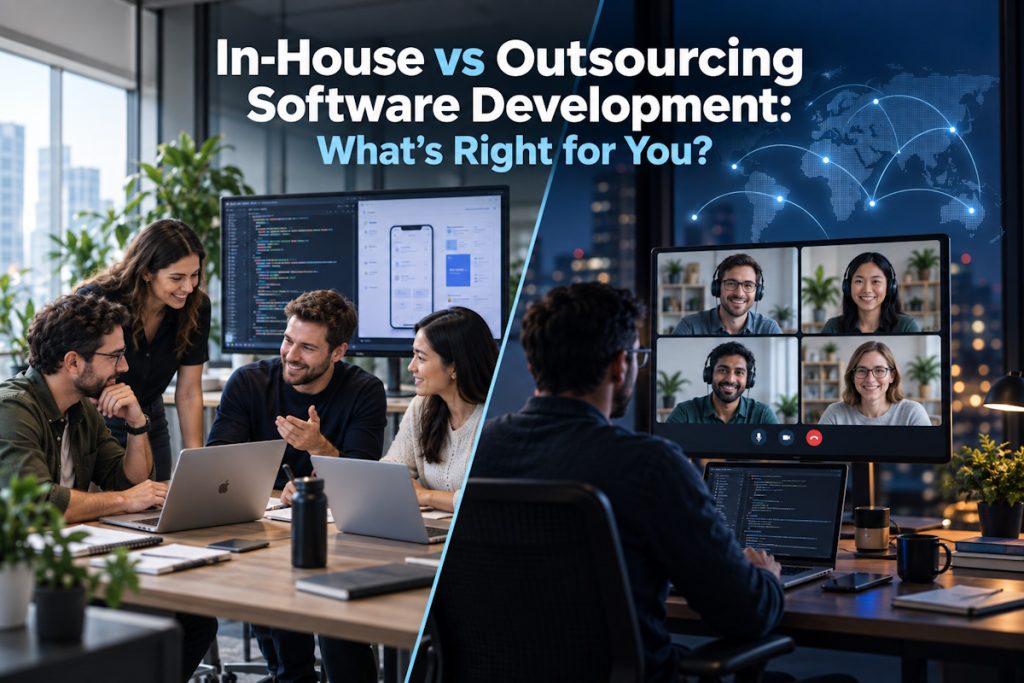
Every technology executive, startup founder, and product leader eventually confronts a critical organizational fork in the road: should you recruit an internal engineering department, or should you partner with an external agency to build your software? The decision rarely comes down to simple cost-per-hour mathematics. Instead, it involves balancing execution speed, long-term technical debt, product ownership, institutional knowledge, and capital allocation.
Making the right choice between in-house vs outsourcing software development requires understanding how each model influences daily engineering operations and long-term business sustainability. Selecting the wrong path can either drain capital reserves through prolonged hiring cycles and overhead or compromise product architecture through misaligned vendor incentives and fragmented codebases. Determining which structure fits your company depends on the nature of your product, your runway, and your existing technical leadership.
Evaluating the In-House Development Model
Building an internal software development team means hiring full-time engineers, product managers, quality assurance specialists, and DevOps personnel who work exclusively for your organization. This approach is historically viewed as the standard approach for product-centric technology businesses, but it introduces distinct operational realities that require substantial capital and managerial infrastructure.
When Internal Engineering Provides the Greatest Value
An in-house team is typically justified when the software being built represents the core competitive moat of your business. If your enterprise valuation and primary value proposition rest entirely on proprietary algorithms, complex domain-specific workflows, or novel architecture, retaining that intellectual property and day-to-day context within your direct payroll is vital.
Internal engineers offer cultural alignment and immersion in the problem space that external contributors rarely match. Over months and years, full-time employees accumulate institutional memory. They understand not just how the codebase works, but why specific architectural tradeoffs were made, which customer edge cases caused previous outages, and how the business strategy translates into technical priorities. This contextual depth enables rapid product iteration when requirements change frequently or when user feedback demands fundamental architectural pivots.
The Realities of Hiring Overhead and Team Retention
While an in-house development team offers deep alignment, it demands substantial upfront investment and ongoing organizational overhead. Sourcing qualified software engineers is historically competitive and time-consuming. Recruiting cycles for senior developers, engineering managers, and cloud architects frequently stretch from eight to sixteen weeks per role, delaying project kickoffs.
Beyond recruitment agency fees and signing bonuses, companies must account for the fully burdened cost of employment. This includes healthcare, equity packages, retirement benefits, software licensing, continuous training, and payroll taxes. Furthermore, engineering turnover introduces severe operational disruption. When a key developer leaves an internal team, critical domain knowledge often departs with them unless thorough documentation standards and knowledge-transfer processes are rigidly enforced.
Evaluating the Software Development Outsourcing Model
Software development outsourcing involves contracting an external vendor, such as a specialized agency, a systems integrator, or a dedicated offshore development center, to design, build, test, or maintain software systems. Once viewed primarily as a defensive cost-cutting exercise, modern outsourcing is increasingly used as a strategic mechanism to accelerate product delivery and access hard-to-find technical capabilities.
Velocity, Elasticity, and Technical Breadth
The primary operational advantage of choosing to outsource software development is immediate velocity. Established development agencies maintain pre-vetted teams of engineers, project managers, and quality assurance engineers who have worked together across previous deployments. Rather than spending months screening applicants, a company can initiate development within weeks.
Outsourcing also provides architectural elasticity. An enterprise may require deep machine learning expertise during an initial three-month modeling phase, followed by heavy front-end engineering during user interface implementation, followed by specialized cloud infrastructure security hardening. Maintaining full-time specialists on staff for each of these transient phases is financially inefficient for most organizations. Outsourcing allows companies to scale specialized competencies up or down in direct alignment with project milestones.
Governance, Alignment, and Architectural Risks
Outsourcing is not without significant points of failure. The most frequent breakdowns occur in technical governance and requirements clarity. If an organization lacks internal technical leadership capable of reviewing pull requests, evaluating architectural diagrams, and assessing code hygiene, it becomes vulnerable to compounding technical debt.
External vendors are commercially incentivized to deliver features against an agreed statement of work within specific time boundaries. If contracts are structured poorly, vendors may prioritize rapid delivery over long-term maintainability, resulting in fragile test coverage, insufficient documentation, or tightly coupled code that becomes difficult for future teams to modify. Successful outsourcing requires structured oversight, rigorous acceptance criteria, and clear protocols for code reviews and continuous integration.
Strategic Tradeoffs: Comparing Core Operational Dimensions
Choosing between internal hiring and external contracting requires evaluating how each model performs across four primary variables: cost predictability, intellectual property retention, delivery velocity, and architectural control.
-
- Cost Structure and Capital Efficiency: In-house teams represent a fixed operational expenditure that remains constant regardless of whether your product roadmap is accelerating or contracting. Outsourcing converts development expenses into variable costs, allowing leadership to adjust spending based on milestone validation, funding rounds, or revenue fluctuations.
-
- Intellectual Property and Code Ownership: While legal contracts generally assign code ownership to the client, real intellectual property consists of more than copyright. It includes system comprehension, operational instincts, and architectural context. In-house teams retain this context internally, whereas outsourced arrangements require deliberate documentation handoffs to prevent institutional amnesia when contracts terminate.
-
- Execution Velocity: For greenfield projects requiring immediate market testing, outsourcing almost always reaches production faster due to preexisting team dynamics and zero recruitment lead time. However, for mature platforms requiring continuous, granular iterations based on daily user feedback, an embedded in-house team usually outpaces an agency constrained by change-order requests and scope renegotiations.
-
- Quality Control and Standards Enforcement: Controlling quality in-house relies on internal engineering culture, automated testing standards, and peer code reviews. Controlling quality with an external vendor requires contractual definitions of done, automated static analysis gates, acceptance testing, and formal governance frameworks.
The Hybrid Approach: Blending Core Ownership with External Scale
The modern software landscape does not enforce an absolute binary between building entirely in-house or delegating everything to a third party. A growing majority of scaling technology companies adopt a hybrid engineering framework to optimize both speed and long-term control.
In a standard hybrid structure, the company maintains a core in-house team responsible for strategic product direction, system architecture, core intellectual property, and high-stakes security modules. This internal nucleus acts as the guardian of the platform’s architectural integrity. To accelerate roadmap execution, the company pairs this core team with an external software development team through staff augmentation or dedicated project-based pods.
For example, internal engineers might develop the proprietary data-processing engine, while an outsourced team constructs internal admin dashboards, third-party API integrations, and secondary mobile applications. This model preserves core knowledge within the business while leveraging external elasticity to clear technical backlogs and meet aggressive market deadlines.
A Practical Decision Framework for Technology Leaders
Before committing resources to recruitment pipelines or agency contracts, leadership teams should evaluate four foundational criteria to determine the appropriate operational model.
1. Is the Software Your Primary Core Competency?
If you are building a commercial software-as-a-service (SaaS) platform where the codebase is the direct product sold to customers, you must eventually build internal engineering capacity. Even if you use an agency to deploy an initial minimum viable product, your long-term operating plan should prioritize transitioning core platform stewardship in-house. Conversely, if the software is an internal workflow tool, a customer portal for an existing service business, or an automation pipeline supporting a non-technical enterprise, permanent internal engineering overhead is rarely warranted.
2. What Is Your Timeline to Value?
If market conditions require launching a validated application within three to six months to secure follow-on funding or capture a transient market window, attempting to hire an entire engineering department from scratch poses existential delivery risk. Under tight timelines, partnering with an experienced development firm is the pragmatic choice to establish momentum.
3. Do You Have In-House Technical Leadership?
Outsourcing software development without a qualified internal technical stakeholder, such as a fractional or full-time CTO, Vice President of Engineering, or senior architect, significantly elevates project risk. Non-technical founders who outsource without independent architectural validation often struggle to verify whether delivered code meets baseline scalability, security, and maintainability standards. If no technical leadership exists internally, your first hire should be an experienced technical leader who can evaluate vendors, define requirements, and govern the development process.
4. What Is the State of Your Project Scope?
Outsourced partnerships function most effectively when project scope, workflows, and business objectives are well defined. If your product concept is still speculative and requires daily exploratory changes based on customer interviews, managing an agency via iterative scope adjustments can become legally and financially burdensome. Highly ambiguous, discovery-driven exploration is often handled more fluidly by a small, dedicated internal founding team.
What to Verify Before Moving Forward
Navigating the balance between an in-house development team and external engineering partners is an iterative process rather than a permanent, unalterable commitment. Many of the world’s most successful technology enterprises began their development journeys using outsourced agencies to construct initial working prototypes, systematically transitioning those codebases to full-time internal teams once market demand was validated and capital was secured.
Before executing development contracts or opening expensive recruitment pipelines, conduct a rigorous assessment of your current operational maturity. Audit the clarity of your technical specifications, verify the availability of internal stakeholders to review architecture, and realistically evaluate your financial runway over the next eighteen months. Whether you choose internal recruitment, complete vendor outsourcing, or a balanced hybrid structure, establishing clear technical standards, rigorous continuous deployment pipelines, and absolute transparency in code ownership will protect your organization from costly rework down the line.
Frequently Asked Questions
1. Which model is more cost-effective over a multi-year timeline?
The financial outcome depends on product stability. For short-term initiatives or projects with clear delivery endpoints, outsourcing is significantly more cost-effective because it avoids recruitment fees, severance risks, and permanent employment overhead. However, for a core platform requiring continuous feature development over several years, maintaining an efficient in-house team generally yields lower aggregate costs than paying agency billable rates indefinitely.
2. How do businesses protect intellectual property when working with external developers?
Intellectual property protection requires clear contractual structuring, strict technical access management, and code repository governance. Contracts must include explicit work-for-hire clauses that assign all copyrights, patents, and trade secrets to your company upon payment. Technically, companies should maintain ownership of code repositories, cloud infrastructure, and deployment keys, granting external developers least-privilege access rather than administrative control.
3. When should a company transition from an outsourced team to an in-house team?
The transition typically makes sense when the product reaches clear product-market fit, generating predictable revenue or securing significant capital investment that justifies fixed payroll obligations. A transition is also recommended when feature iteration becomes constant, daily customer feedback dictates rapid architectural adjustments, or system maintenance requires deep, uninterrupted domain knowledge.
4. Can an outsourced development partner maintain high engineering standards?
Yes, provided the relationship is governed correctly. Quality depends on vendor vetting and the enforcement of engineering standards. Organizations should mandate automated unit testing, continuous integration checks, static code analysis, and documented peer reviews as formal acceptance criteria within their service level agreements. Code should be pushed directly to company-owned repositories subject to internal sign-offs.
5. What is the most critical mistake to avoid when outsourcing development?
The most common failure is treating an external vendor as a substitute for product vision and technical leadership. Outsourcing firms excel at engineering execution against defined parameters, but they cannot invent your business model or define market requirements. Without an engaged internal product owner who actively clarifies workflows and verifies deliverables, projects frequently suffer from scope drift and technical misalignment.
