
What to Ask About Software Maintenance Before Hiring a Development Company
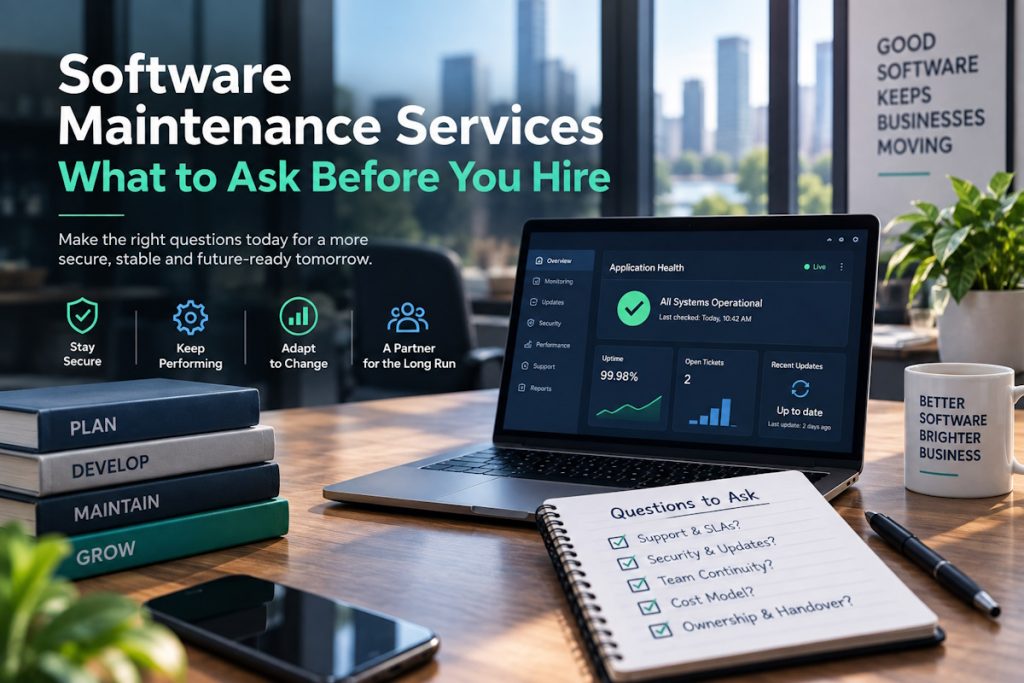
Custom software initiatives often encounter their most dangerous risks not during active development, but in the months immediately following production deployment. Procurement teams and technology leaders routinely spend months negotiating sprint cadence, feature backlogs, and delivery milestones, treating post-deployment operations as a secondary detail to address after launch. When production errors surface, cloud dependencies shift, or critical third-party APIs introduce breaking changes, organizations discover too late that their contract provides no framework for continuous operational reliability.
Selecting an engineering partner without thoroughly vetting their software maintenance services creates persistent technical and financial fragility. Software is never truly finished; it is an evolving operational asset requiring proactive monitoring, dependency updates, security patches, and architectural governance. Asking specific operational and commercial questions during initial vendor evaluation allows buyers to distinguish between development shops that abandon projects at deployment and strategic partners prepared to sustain application performance across its full lifecycle.
Why Maintenance Planning Must Happen Before Development Begins
Negotiating post-launch support after code delivery eliminates your procurement leverage and exposes production systems to preventable downtime. Software decay begins the moment code merges into a main branch. Operating systems receive security patches, external libraries release major revisions, browser rendering engines update, and underlying infrastructure services adjust their interfaces. If an application does not receive systematic updates, its performance degrades and security vulnerabilities multiply.
A capable software development company designs architectures with operational support in mind. When maintenance requirements are established during initial discovery, development teams make better architectural decisions regarding modularity, automated testing, logging, and observability. Conversely, vendors that focus exclusively on project handover often cut corners on documentation, automated deployment scripts, and test coverage, maximizing short-term build velocity while saddling the client with compounding technical debt that makes ongoing maintenance expensive.
Core Questions Regarding Service Level Agreements and Support Tiers
A generic commitment to support an application offers zero legal or operational protection when production outages occur. When evaluating application maintenance services, buyers must look past high-level promises and examine the precise operational mechanics defined in the vendor Service Level Agreement (SLA).
What defines your incident classification and response timeframes?
Every maintenance agreement categorizes incidents by severity, usually ranging from critical outages (Severity 1) to minor cosmetic defects (Severity 4). You must clarify how the vendor categorizes incidents and what metrics govern their response. Inquire specifically about the difference between response time and resolution time. A guaranteed response time of fifteen minutes simply means an automated notification was acknowledged or a ticket was assigned; it provides no timeline for diagnosing the root cause or restoring service.
What coverage hours apply, and how are escalations handled?
Business operations rarely align neatly with a vendor standard business hours. If your users operate across multiple time zones or rely on uninterrupted digital workflows, you must verify whether support teams are available 24/7/365, on-call during weekends, or strictly operational during local working hours. Determine who handles after-hours emergencies, what escalation paths exist when an engineer fails to acknowledge an alert, and whether emergency interventions incur premium billing rates.
Evaluating Engineering Team Continuity and Knowledge Retention
One of the most disruptive operational problems occurs when the engineering team that built an application departs, leaving maintenance tasks to junior support personnel who have never seen the codebase. Knowledge transfer friction causes simple bug fixes to take days and increases the probability of regression errors.
Before entering an agreement, ask the vendor these questions regarding staffing models:
-
- Will the original development team handle post-launch maintenance? If the engineering team transitions immediately to another build project, ask how knowledge transfer occurs and who will maintain the production codebase.
-
- Is maintenance assigned to a dedicated support desk or a shared pool? Shared developer pools often treat maintenance tickets as low-priority interruptions between new project sprints, causing slow turnaround times on non-critical issues.
-
- What documentation standards are maintained throughout the build? Verify that the team produces architecture diagrams, environment setup runbooks, database schemas, and API documentation to prevent reliance on institutional memory.
-
- What is the vendor developer turnover rate? High turnover within a vendor engineering staff introduces constant disruption, as newly assigned engineers must repeatedly relearn your business logic on your budget.
How the Vendor Manages Security Vulnerabilities and Upgrades
Software ecosystems rely heavily on third-party packages, open-source dependencies, and commercial cloud services. Proactive software support services must include scheduled, preventative maintenance rather than passive issue remediation.
Inquire specifically about how the vendor monitors upstream dependencies. Ask whether they run automated vulnerability scanners against code repositories, how quickly they patch critical Common Vulnerabilities and Exposures (CVEs), and how they handle deprecation cycles for major frameworks like React, Node.js, or .NET. Upgrading an application framework two versions forward is a routine operational task; upgrading an application framework four major versions forward because maintenance was ignored for three years is an expensive, high-risk refactoring project.
Similarly, clarify cloud infrastructure responsibilities. Establish whether the vendor monitors cloud expenditure, reviews serverless execution limits, manages SSL/TLS certificate renewals, and tests automated database backups. Many organizations assume their development partner is testing backup restoration procedures regularly, only to discover during a data corruption incident that snapshots were failing silently for months.
Understanding Commercial Models for Post-Launch Maintenance
Maintenance contracts vary significantly in structure, pricing, and resource allocation. Choosing an inappropriate billing model can lead to wasted budget during quiet operational periods or severe resource shortages during critical production incidents. Evaluating commercial structures before signing allows you to model total cost of ownership accurately.
Retainers Versus Time and Materials
Most post-launch maintenance contracts follow one of two commercial frameworks. Dedicated monthly retainers reserve a specific allocation of engineering hours each month to handle bug fixes, minor enhancements, monitoring, and updates. This provides resource predictability, though you must negotiate whether unused hours roll over into subsequent months or expire immediately.
Time and materials models bill strictly for hours logged against specific support tickets. While this structure avoids monthly payments during periods of low activity, it leaves you without dedicated capacity. When a sudden issue emerges, you must wait for developer availability, which can cause significant operational delays.
Warranty Periods Versus Continuous Service Agreements
A standard development contract often includes a warranty period, commonly lasting between thirty and ninety days post-deployment. Clarify the precise scope of this warranty. In most engineering agreements, warranties cover only defects where the software fails to conform to originally approved functional specifications. A warranty does not cover performance tuning under unexpected user volume, modifications required by third-party API changes, security patches for newly discovered framework vulnerabilities, or new feature requests. Relying on a warranty as a substitute for structured software maintenance services leaves critical operational gaps unprotected.
Transition Protocols and Intellectual Property Ownership
A software development relationship may eventually end, whether you choose to internalize engineering operations or engage a different specialist. The worst time to negotiate transition requirements is during a contentious contract termination.
Confirm that your organization maintains complete, unencumbered ownership of all source code, automated deployment configurations, infrastructure-as-code scripts, continuous integration and deployment (CI/CD) pipelines, and database assets throughout the engagement. Ensure that the vendor commits to providing comprehensive handover assistance if maintenance moves elsewhere. Ask how long offboarding takes, what artifacts are delivered, and whether transition support is billed at standard hourly rates or elevated offboarding rates.
If an agency relies on proprietary internal libraries, boilerplate code, or proprietary hosting environments to support your application, evaluate the risk of vendor lock-in. You must confirm that any proprietary dependencies can be run independently or replaced without rewriting core application logic.
What to Verify Before Signing a Development Agreement
Protecting your software investment requires formalizing operational expectations directly within your Master Services Agreement (MSA) and initial Statement of Work (SOW). Never accept verbal assurances that maintenance will be figured out closer to deployment.
Review candidate proposals against a clear set of operational baselines:
-
- Contractual definitions of severity levels, response targets, and clear escalation protocols.
-
- Explicit commitments regarding the engineers assigned to long-term application maintenance services.
-
- Scheduled routines for security patching, vulnerability scanning, and framework updates.
-
- Predictable commercial models governing rollover hours, emergency support rates, and offboarding support.
-
- Continuous access to source repositories, staging environments, production monitoring tools, and deployment pipelines.
By establishing these requirements during vendor selection, you force prospective partners to demonstrate operational discipline, technical foresight, and commercial transparency, ensuring your application remains secure, performant, and valuable long after launch day.
Frequently Asked Questions
1. What is the typical cost of software maintenance services relative to initial development?
Industry standards typically see annual software maintenance services cost between fifteen and twenty-five percent of the initial software development budget. This range covers routine bug remediation, security patches, minor UI adjustments, dependency updates, and platform monitoring. Complex applications with deep third-party integrations, high regulatory compliance requirements, or intensive data processing needs may require higher ongoing investments.
2. What is the difference between a software warranty and continuous maintenance?
A software warranty is a short-term commitment, usually lasting 30 to 90 days, where a vendor fixes bugs caused by non-compliance with the original technical specification at no added cost. Continuous maintenance is an active, ongoing agreement covering proactive security patching, performance optimization, third-party API changes, infrastructure scaling, and new functional updates that occur outside the initial scope.
3. How do response times differ between application maintenance services tiers?
Response times correspond to incident severity. Critical issues that cause complete system outages or data exposure typically require response times within fifteen to sixty minutes under a standard SLA. Non-critical issues, such as cosmetic defects or minor workflow errors that do not block business operations, generally have response windows ranging from 24 to 72 business hours.
4. Can we switch our software support services provider after the application is built?
Yes, provided you retain full intellectual property ownership, source code access, automated CI/CD configurations, and comprehensive technical documentation. Switching providers requires an onboarding discovery period where the incoming team audits code quality, sets up local environments, reviews test coverage, and familiarizes themselves with the system architecture.
