Why Traditional Skill Verification Systems Are Failing at Scale
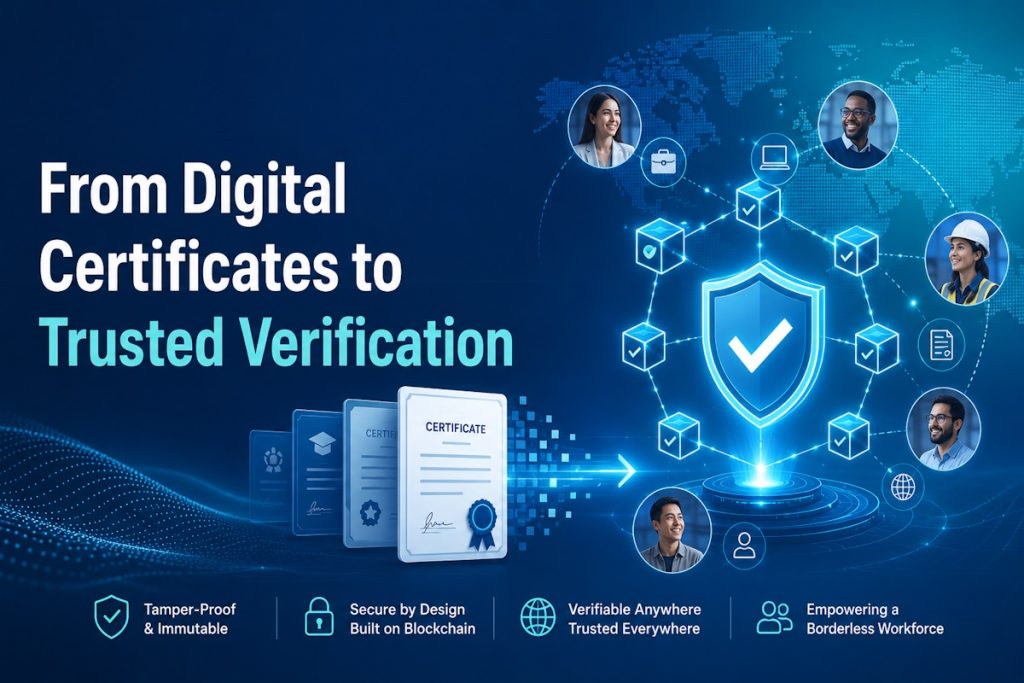
The global workforce is becoming increasingly digital, distributed, and mobile, but the systems used to verify skills and credentials still operate as if employment is local, static, and institution-controlled. That mismatch is creating serious operational friction across hiring, workforce mobility, education, and compliance ecosystems.
Today, a candidate may complete certifications from multiple platforms, work across freelance marketplaces, contribute to decentralized projects, and gain practical skills outside formal institutions. Yet most verification systems still depend on PDFs, manual checks, email confirmations, or isolated databases that cannot communicate with one another efficiently.
The problem is no longer just about digitizing certificates. Most certificates are already digital. The deeper issue is trust, interoperability, and verification at scale.
This is where blockchain infrastructure is starting to shift the conversation. Not as a speculative financial layer, but as a trust architecture for digital identity and skill verification systems.
Having worked on blockchain-backed identity infrastructure and large-scale workforce verification models, I have seen that the real complexity does not come from issuing credentials. It comes from ensuring those credentials remain portable, verifiable, tamper-resistant, and usable across institutions, employers, platforms, and borders without creating operational chaos.
The Structural Problem
Fragmented Credential Ecosystems Are Creating Operational Friction
Traditional skill verification systems were built for a slower workforce economy. Universities issued degrees. Employers verified documents manually. Career progression happened within relatively stable organizational structures.
That model is breaking down.
Modern workforce ecosystems are fragmented. A single individual may possess academic qualifications, platform-based certifications, informal training experience, project-based proof of work, and employer-issued credentials spread across disconnected systems.
The operational challenge becomes visible when verification needs to happen at scale.
Employers spend enormous amounts of time validating resumes, contacting institutions, verifying work experience, and checking document authenticity. Educational institutions maintain isolated databases with different standards and inconsistent accessibility. Freelancers and gig workers struggle to prove skills outside traditional employment structures. Cross-border verification becomes even more difficult because trust frameworks vary between countries and organizations.
The inefficiency compounds quickly.
In many cases, the verification process itself becomes a bottleneck in hiring, workforce deployment, and skill recognition. Delays increase operational costs while also creating opportunities for fraud, credential manipulation, and inconsistent validation standards.
The problem is not the absence of digital records. It is the absence of trusted, interoperable verification infrastructure.
India’s Credential Gap Is Already Measurable
The problem is not theoretical. Thirty-two fake universities operating undetected, millions of graduates who cannot clear basic employability assessments. This is what verification failure looks like at the country level. The documents exist. The degrees are printed. What is missing is any reliable mechanism to distinguish legitimate credentials from fraudulent ones without investing significant manual effort in each case. Employers absorb this cost through extended screening cycles and bad hires that rarely get traced back to credential failure specifically. Incremental fixes stricter audits, additional document uploads, and more phone calls to institutions cannot close a gap this structural.
Where Blockchain Changes the Model
Moving Trust From Institutions to Infrastructure
Blockchain changes the verification model because it separates credential trust from centralized ownership.
In traditional systems, verification depends heavily on the issuing institution remaining available, accessible, and trusted indefinitely. If records become unavailable, organizations close, or systems change, verification becomes difficult.
Blockchain-backed credentials operate differently. The trust layer is embedded into the infrastructure itself through immutable verification records, cryptographic signatures, and distributed validation mechanisms.
That distinction matters operationally.
A verifiable credential system allows institutions to issue digitally signed credentials that can be independently validated without requiring constant manual intervention from the issuer. The credential holder maintains ownership and portability while verification becomes significantly faster and more reliable.
This becomes especially important in large workforce ecosystems where millions of credentials may need to move across platforms, employers, training providers, and government systems.
The practical value is not decentralization for its own sake. The value comes from reducing friction inside verification workflows.
What Execution Actually Looks Like
The conceptual case for blockchain-backed verification is largely settled. The harder question is whether platforms can implement it with operational discipline interoperability built in from day one, governance defined before scale forces the issue, and credential portability controlled by the holder rather than the institution. Skill Passport in India is one early attempt at this positioning as a unified identity layer for professional credentials rather than another siloed issuance tool. Whether it succeeds will depend far less on the technology and more on whether it resolves the coordination problem across employers, institutions, and platforms simultaneously.
For example, if a worker applies for employment in another country or across multiple platforms, the verification process should not require repeated manual document validation every time. Infrastructure should allow trusted verification to happen consistently without recreating the process repeatedly.
That is where blockchain functions more as infrastructure than as technology branding.
The Infrastructure Challenge
Why Building Verifiable Credential Systems Is More Complex Than It Appears
The biggest misconception around blockchain-backed identity systems is that issuing credentials is the difficult part. It is not.
The difficult part is building infrastructure that can scale operationally while maintaining interoperability, privacy, governance controls, and verification reliability.
Population-scale systems introduce complexity quickly.
Different institutions use different credential formats. Governments maintain separate compliance frameworks. Employers require varying levels of verification depth. Workforce platforms often prioritize usability over verification rigor. Educational ecosystems evolve independently across regions.
Creating a verification layer that works across all these environments is not simply a technical challenge. It is an operational coordination challenge.
One issue that emerges quickly is interoperability. If every institution or platform creates its own isolated credential framework, the ecosystem becomes fragmented again, even if blockchain is involved.
This is why standards matter significantly.
Verifiable credentials need common frameworks for issuance, validation, revocation, metadata handling, and access permissions. Without standardized interoperability layers, organizations end up recreating isolated digital silos under new technology labels.
Another challenge involves privacy and data ownership.
Skill identity systems contain sensitive personal information. Poorly designed systems risk exposing unnecessary data during verification workflows. The objective should not be placing all personal information directly on-chain. That creates scalability and privacy problems immediately.
Instead, blockchain should function as a trust and validation layer while sensitive information remains securely controlled through permissioned access systems and cryptographic verification methods.
The distinction is critical because many early blockchain identity projects underestimated operational privacy requirements.
Why Scale Changes Everything
Population-Scale Verification Requires Different Thinking
Small-scale verification systems can operate effectively with partial automation and manual oversight. Large-scale systems cannot.
When identity infrastructure expands across millions of users, operational assumptions change entirely.
Verification latency becomes a real problem. Infrastructure costs increase. Governance disputes become more complex. Data synchronization across institutions becomes difficult. System reliability becomes critical because failure impacts workforce access directly.
I have seen how quickly operational complexity expands once systems move beyond controlled pilot environments into real-world distributed ecosystems.
For example, a skill identity platform serving a small developer community may function effectively with relatively simple workflows. But once similar systems attempt to serve blue-collar workers, gig economy participants, universities, employers, certification bodies, and government programs simultaneously, infrastructure pressure increases significantly.
The challenge is no longer technology capability alone. It becomes ecosystem coordination.
Scalable systems require resilient architecture, clear governance layers, distributed verification models, and infrastructure capable of supporting long-term institutional participation.
That is why many digital identity systems struggle during expansion phases. They underestimate operational scale complexity.
Governance and Trust
Technology Alone Cannot Solve Verification Problems
Technology alone cannot solve trust problems.
One of the most important lessons from digital identity infrastructure is that governance models matter as much as technical architecture.
Who can issue credentials? Who validates issuers? How are fraudulent credentials revoked? What happens when institutions merge, shut down, or lose credibility? How are disputes handled across jurisdictions?
These questions become increasingly important as systems expand.
In traditional systems, institutional authority acts as the primary trust anchor. In decentralized verification ecosystems, trust becomes distributed across infrastructure rules, issuer standards, governance frameworks, and validation mechanisms.
That transition requires careful design.
Over-centralized governance undermines interoperability and portability. Completely unstructured governance creates verification inconsistency and ecosystem instability.
The balance is difficult but necessary.
Successful infrastructure systems usually focus less on eliminating institutions and more on enabling trusted collaboration between them.
What Organizations Are Getting Wrong
Treating Blockchain as a Product Instead of Infrastructure
Many organizations still approach digital credentials as isolated software project instead of long-term infrastructure systems.
The focus often remains limited to digitizing certificates or creating blockchain-based records without addressing operational integration challenges. As a result, organizations build technically functional systems that struggle with adoption, interoperability, or real-world usability.
Another common mistake is treating blockchain as the primary product rather than the supporting infrastructure layer.
Employers, institutions, and workers are not looking for blockchain exposure. They are looking for trusted, fast, portable verification systems that reduce operational friction.
The infrastructure should remain largely invisible to end users.
Organizations also underestimate how fragmented workforce ecosystems truly are. Educational systems, employers, workforce platforms, and government databases rarely operate with aligned standards or synchronized infrastructure assumptions.
Building scalable verification systems requires designing for fragmentation from the beginning rather than assuming centralized coordination will emerge naturally later.
The Long-Term Implications
The Future of Workforce Identity Depends on Trusted Verification Infrastructure
The future of workforce identity will depend heavily on a verification infrastructure that can operate across institutional, geographic, and platform boundaries without creating excessive operational complexity.
Resumes, PDFs, screenshots, and isolated certification portals are increasingly insufficient for modern workforce environments where skills evolve continuously, and work happens across distributed ecosystems.
Blockchain-backed verification systems offer an opportunity to improve trust, portability, and interoperability, but only if implemented with realistic operational thinking.
The objective should not be creating another technology layer for its own sake. The objective should be to reduce friction inside workforce mobility, hiring, compliance, and skill recognition systems.
That requires infrastructure thinking rather than feature thinking.
The future of skill identity is not simply about digitizing certificates. It is about building a trusted, interoperable, and scalable verification infrastructure that can function across institutions, employers, platforms, and borders without collapsing under operational complexity.
The technology itself is only one part of the equation. The real challenge is building systems that remain reliable when millions of people, organizations, and verification workflows begin depending on them simultaneously.