AI Is Rewriting Data Risk: Are Enterprises Ready for What’s Next?
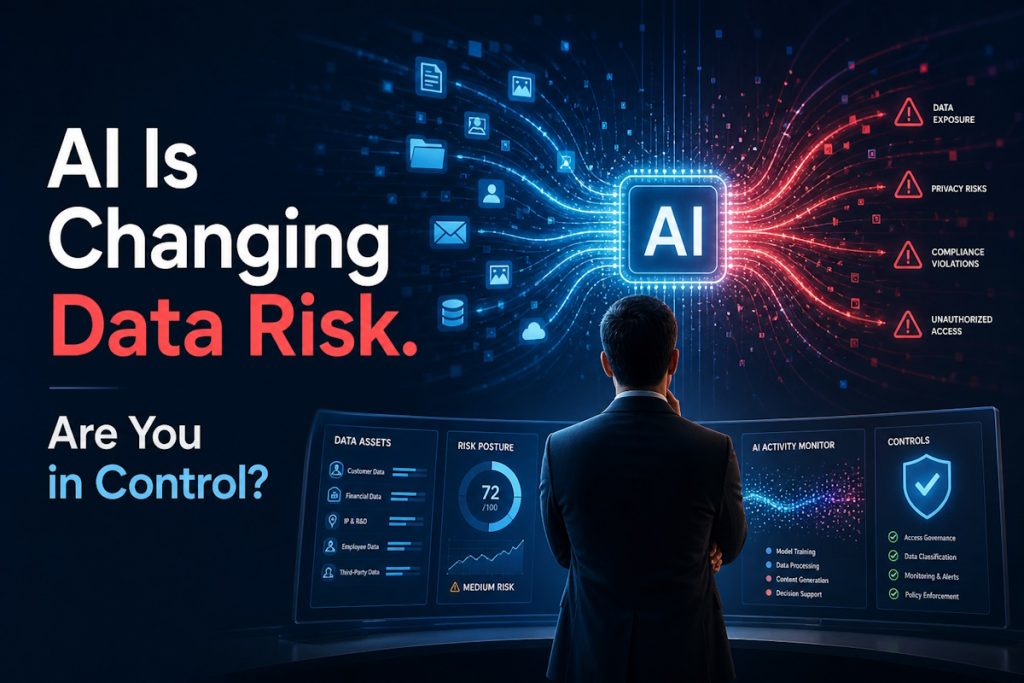
AI Is Rewriting Data Risk: Are Enterprises Ready for What’s Next?
AI isn’t just another technology wave. It’s quietly changing how data behaves inside organizations, and most security models haven’t caught up.
Enterprises are rushing to embed AI into finance, reporting, customer workflows, and internal tools. The assumption is that existing controls—access management, encryption, monitoring—will extend naturally. They won’t. AI doesn’t just move or store data. It interprets it, recombines it, and surfaces it in ways that don’t follow traditional boundaries.
That’s where the problem starts.
The Risk Is No Longer Where You Think It Is
For years, data protection has focused on preventing unauthorized access—who can see what, and under what conditions. That model works when data access is direct and predictable.
AI breaks that predictability.
Sensitive data doesn’t need to be directly accessed to be exposed. It can show up in generated outputs, inferred through context, or pulled into responses from multiple underlying sources. The exposure is indirect, often subtle, and easy to miss.
In financial and accounting environments, this is particularly risky. AI systems are being used to summarize reports, analyze transactions, and generate insights from sensitive datasets. A single response that blends restricted and permitted data can quietly cross boundaries that policies were designed to enforce.
No alarms. No obvious breach. Just the wrong data in the wrong place.
Enterprises Are Expanding Access Without Realizing It
AI tools work best when they have broad access. That’s the selling point—connect everything, analyze everything, generate insights faster.
In practice, this often translates into overly permissive access models. Systems are given wide visibility into data repositories, with the expectation that the application layer will handle what users see.
Over time, this creates a compounding risk. Permissions are granted for functionality, not revisited for necessity. What starts as convenience becomes persistent exposure.
And unlike traditional systems, where access is explicit, AI operates through interaction. A user doesn’t need direct permission to a dataset if the system can reference it on their behalf.
That’s a very different risk profile.
Prompting Has Become a New Data Access Layer
One of the least understood shifts is how natural language input changes the security model.
Prompts are flexible, unstructured, and difficult to constrain. They allow users to ask questions in ways that traditional systems never anticipated. This creates new paths for data to surface—intentionally or accidentally.
In some cases, it doesn’t take a malicious actor. It takes a curious user asking the wrong question in the right way.
This is not a theoretical concern. It’s a structural one. When systems are designed to be helpful, they will try to produce the most relevant answer they can. Without strong context controls, that can include information that should never have been part of the response.
Why Traditional Controls Fall Short
Most organizations have invested heavily in data classification, access controls, and monitoring. Those investments still matter, but they don’t address the interaction layer where AI operates.
The issue is not whether data is protected at rest or in transit. It’s whether it is protected at the moment it is interpreted and presented.
That requires a different approach.
Treating AI as just another application is a mistake. It behaves more like a dynamic data access layer—one that continuously queries, processes, and generates outputs based on context. If controls are not applied at that layer, gaps will emerge.
And they won’t look like traditional security failures.
What Needs to Change
Context-Aware Access Control
Access control needs to become context-aware. It’s not enough to define who can access a dataset. Systems need to evaluate whether a specific request, in a specific context, should return certain information.
Real-Time Data Classification
Data classification has to move beyond storage. Labels should influence how data is used in real time, including what can be included in generated outputs.
End-to-End Visibility and Traceability
Visibility needs to improve. Organizations should be able to trace how a response was generated, what data sources were involved, and whether any sensitive information was exposed along the way.
Built-In AI Guardrails and Safeguards
Default safeguards should be built into AI workflows. Limiting the scope of data retrieval, filtering outputs, and enforcing guardrails at the system level should not be optional features.
This Is Not Just a Security Problem
The friction many organizations are feeling is not purely technical. It sits between security, legal, and product teams.
Security wants tighter controls. Legal wants compliance with evolving privacy requirements. Product teams want speed and usability.
AI forces these groups into the same conversation, often without a shared model of how risk actually manifests. Without alignment, decisions become reactive and inconsistent.
The organizations that are getting this right are not adding more reviews. They are embedding policy directly into systems so that decisions are made consistently and automatically.
The Bottom Line
AI is not introducing risk in the way most people expect. It’s not about new attack vectors as much as it is about new exposure paths.
Data is no longer just accessed. It is interpreted, combined, and surfaced dynamically. That changes everything.
Enterprises that continue to rely on static controls will find themselves dealing with issues that are hard to detect and even harder to explain.
The shift required is simple to describe but harder to implement: treat AI as a data access layer, apply controls where interaction happens, and design systems where exposure is limited by default.
AI will continue to move fast. The real question is whether data protection practices will evolve fast enough to keep up.